Owen’s Story pt.5
AN. So everything was going well for you. Bonsai for Life was thriving, your life with Suki was moving forward, and Mei-mei had become such an important part of both the garden and the community. What happened in 2010 to change all that?
OG. Well, Akiko, I think perhaps you're better placed to explain that part of the story than I am!
(Editor's note) Akiko Nakamura first traveled from Hachinohe to Kuji in July 2010 as a reporter for the Daily Tohoku. She came to cover the unexplained death of Mei Matsumoto, known to almost everyone in Kuji as Mei-mei. During several days in Kuji reporting on the death, Akiko spoke with police, residents, and people who had known Mei-mei during the 15 years she lived in the city. It was during that reporting that she first began to hear about Bonsai for Life and its founder, Owen Goodwin. What had begun as a newspaper assignment gradually opened into a much larger story that had begun almost 20 years earlier. A few months after her original report was published, Akiko returned to Kuji to speak with Owen, and that conversation became "Owen's story". Below is the original Daily Tohoku report filed by Akiko Nakamura on July 9th, 2010.
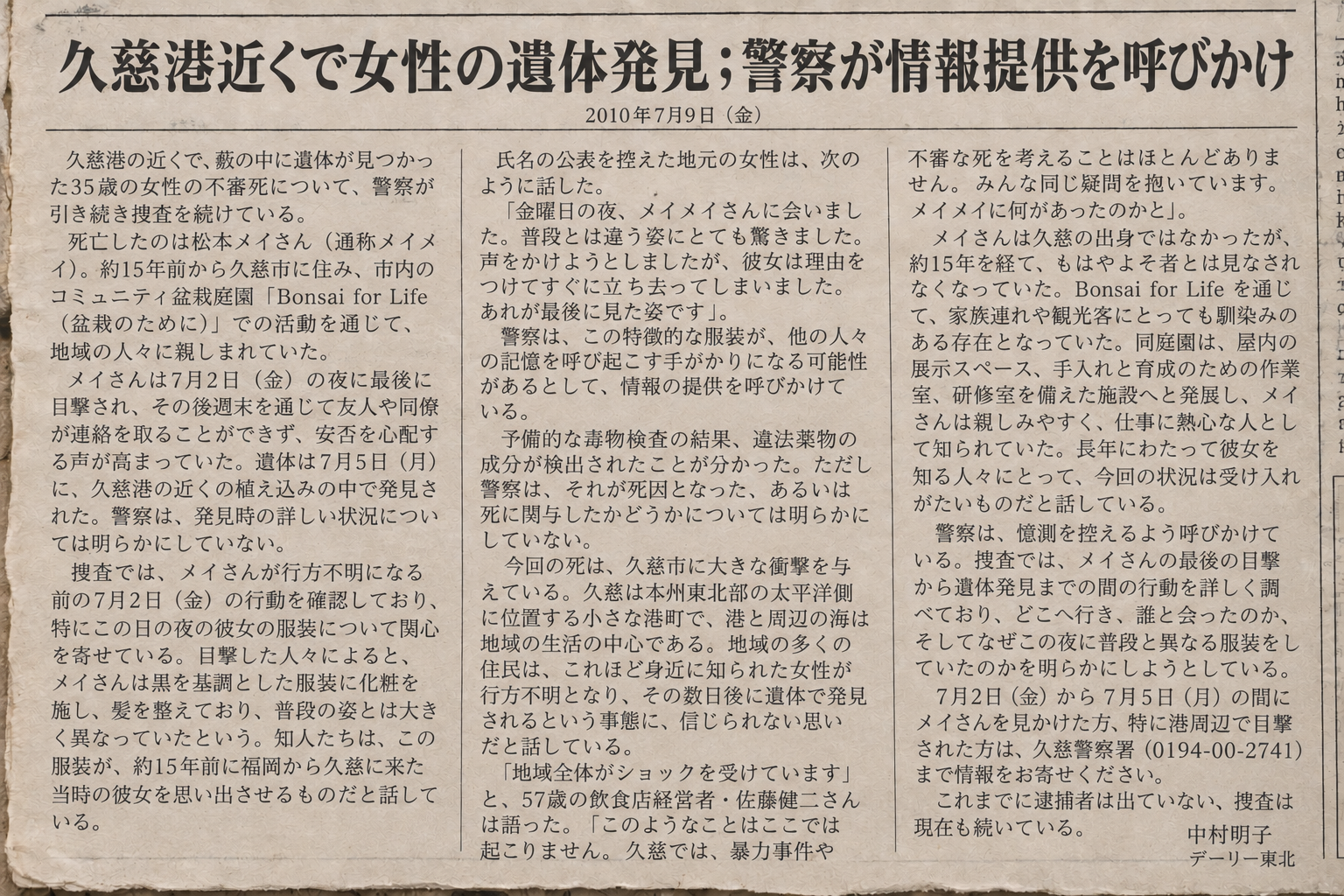
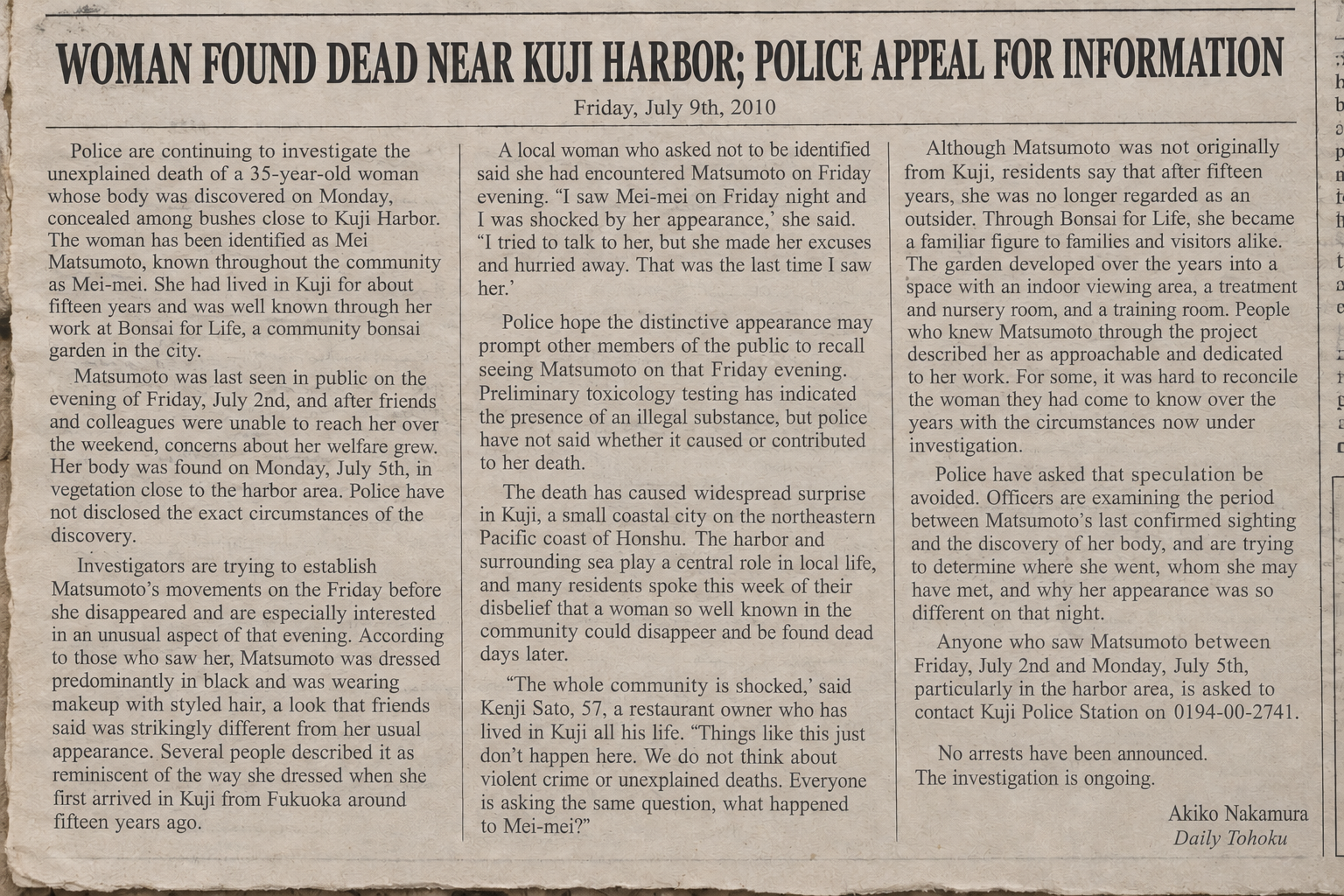
“Woman Found Dead Near Kuji Harbor; Police Appeal for Information”
Kuji, Friday, July 9th, 2010
Police are continuing to investigate the unexplained death of a 35-year-old woman whose body was discovered on Monday concealed among bushes close to Kuji Harbor. The woman has been identified as Mei Matsumoto, known throughout the community as Mei-mei. She had lived in Kuji for about 15 years and was well known through her work at Bonsai for Life, a community bonsai garden in the city. Matsumoto was last seen in public on the evening of Friday, July 2nd, and after friends and colleagues were unable to reach her over the weekend, concerns about her welfare grew. Her body was found on Monday, July 5th, in vegetation close to the harbor area. Police have not disclosed the exact circumstances of the discovery. Investigators are trying to establish Matsumoto's movements on the Friday before she disappeared and are especially interested in an unusual aspect of that evening. According to those who saw her, Matsumoto was dressed predominantly in black and was wearing makeup with styled hair, a look that friends said was strikingly different from her usual appearance. Several people described it as reminiscent of the way she dressed when she first arrived in Kuji from Fukuoka around 15 years ago. A local woman who asked not to be identified said she had encountered Matsumoto on Friday evening. "I saw Mei-mei on Friday night and I was shocked by her appearance," she said. "I tried to talk to her, but she made her excuses and hurried away. That was the last time I saw her". Police hope the distinctive appearance may prompt other members of the public to recall seeing Matsumoto on that Friday evening. Preliminary toxicology testing has indicated the presence of an illegal substance, but police have not said whether it caused or contributed to her death. The death has caused widespread surprise in Kuji, a small coastal city on the northeastern Pacific coast of Honshu. The harbour and surrounding sea play a central role in local life, and many residents spoke this week of their disbelief that a woman so well known in the community could disappear and be found dead days later. "The whole community is shocked," said Kenji Sato, 57. "A restaurant owner who has lived in Kuji all his life. Things like this just don't happen here. We do not think about violent crime or unexplained deaths. Everyone is asking the same question, what happened to Mei-mei?" Although Matsumoto was not originally from Kuji, residents say that after 15 years, she was no longer regarded as an outsider. Through Bonsai for Life, she became a familiar figure to families and visitors alike. The garden developed over the years into a space with an indoor viewing area, a treatment and nursery room, and a training room. People who knew Matsumoto through the project described her as approachable and dedicated to her work. For some, it was hard to reconcile the woman they had come to know over the years with the circumstances now under investigation. Police have asked that speculation be avoided. Officers are examining the period between Matsumoto's last confirmed sighting and the discovery of her body, and are trying to determine where she went, whom she may have met, and why her appearance was so different on that night. Anyone who saw Matsumoto between Friday, July 2nd and Monday, July 5th, particularly in the harbour area, is asked to contact Kuji Police Station on 0194-00-2741.
No arrests have been announced. The investigation is ongoing.
Akiko Nakamura, Daily Tohoku.
AN: How did Mei-mei's death affect you personally?
OG: I was devastated, absolutely devastated by Mei-mei's death, and honestly, I hate even talking about it. When you first came to Kuji to cover Mei-mei's death for The Daily Tohoku, you tried to interview me, and I refused. I just didn't feel up to it. I couldn't do it. And even now, I still have a great deal of difficulty talking about Mei-mei's death without getting too emotional. I've been in Kuji for about 17 years now, and I knew Mei-mei for 15 of those. I'm nearing 40, so that’s nearly half my life. She became such an important person to me, not just someone who worked at the garden. We’d been through so much together. Losing her like that was devastating. Honestly, one of the worst periods I’ve ever gone through in my life. And it’s still very difficult.
AN: And what about Bonsai for Life? How did Mei-Mei's death affect the garden and the project itself?
OG: Obviously, Mei-Mei's death was devastating for everyone around her, but it also had a huge impact on Bonsai for Life. For 15 years, she'd been the heart and soul of the project. She was really running it. And I had taken a real backseat. So when she was suddenly gone, it was catastrophic. Not just in terms of the day-to-day, but in terms of the drive behind the whole thing. Looking back at what Yudai did, it's almost as if he'd had some kind of magical foresight, bringing her here. And it worked. She found something she loved, something she drove forward. And when she was gone, I honestly didn't know if we could or even should go on. Her family took her back to Fukuoka, went through the rituals there, and then they came up and we held a ceremony in the garden with their family, with mine, with people from all over town. And Mei Mei’s family donated a beautiful, hand-carved wooden bench which was placed in amongst the bonsai in the garden for Mei-Mei - a place to sit and contemplate Mei Mei and her life, and everything she’d done for the community. And everyone focused on her special bonsai; the one she’d brought back to the garden from her first trip with Yudai back in 1995. It was an incredibly emotional day. Seeing her family there gave me the push to carry on, to feel we had to. There was this parallel I couldn't ignore. Mr. Tamaguchi's death had set everything in motion, and now Mei-mei's death felt like the end of one era, but also the beginning of another. Her family could see what Bonsai for Life had given her. A life here, a place where she belonged. It doesn’t take away the pain, but it gave something to hold on to and a reason to keep going. And, I learned a lot. About Mei-Mei, about what Bonsai for Life actually meant.
AN. So that's taken us right up to date. How do you see the future for Bonsai for Life?
OG. Through all of its ups and downs, and all of the emotional rollercoasters, I still see Bonsai for Life as a very positive thing, for me, for the community, and for the trees themselves. Since Mei-mei's passing, we brought on someone who had been helping part-time and wanted to step in full-time. I'll never replace Mei-Mei, but we can keep the garden alive and cared for. I've found myself stepping back in more day-to-day. Helping with the transition? This year has been tough, But I do see an optimistic future, and I want Bonsai for Life to remain part of my life for as long as I can.
AN. Thank you, Owen, for sharing all of this. I won't forget it.
OG. Thank you, Akiko.
"Interview conducted by Akiko Nakamura, Kuji, 2010."